Folio · The current release
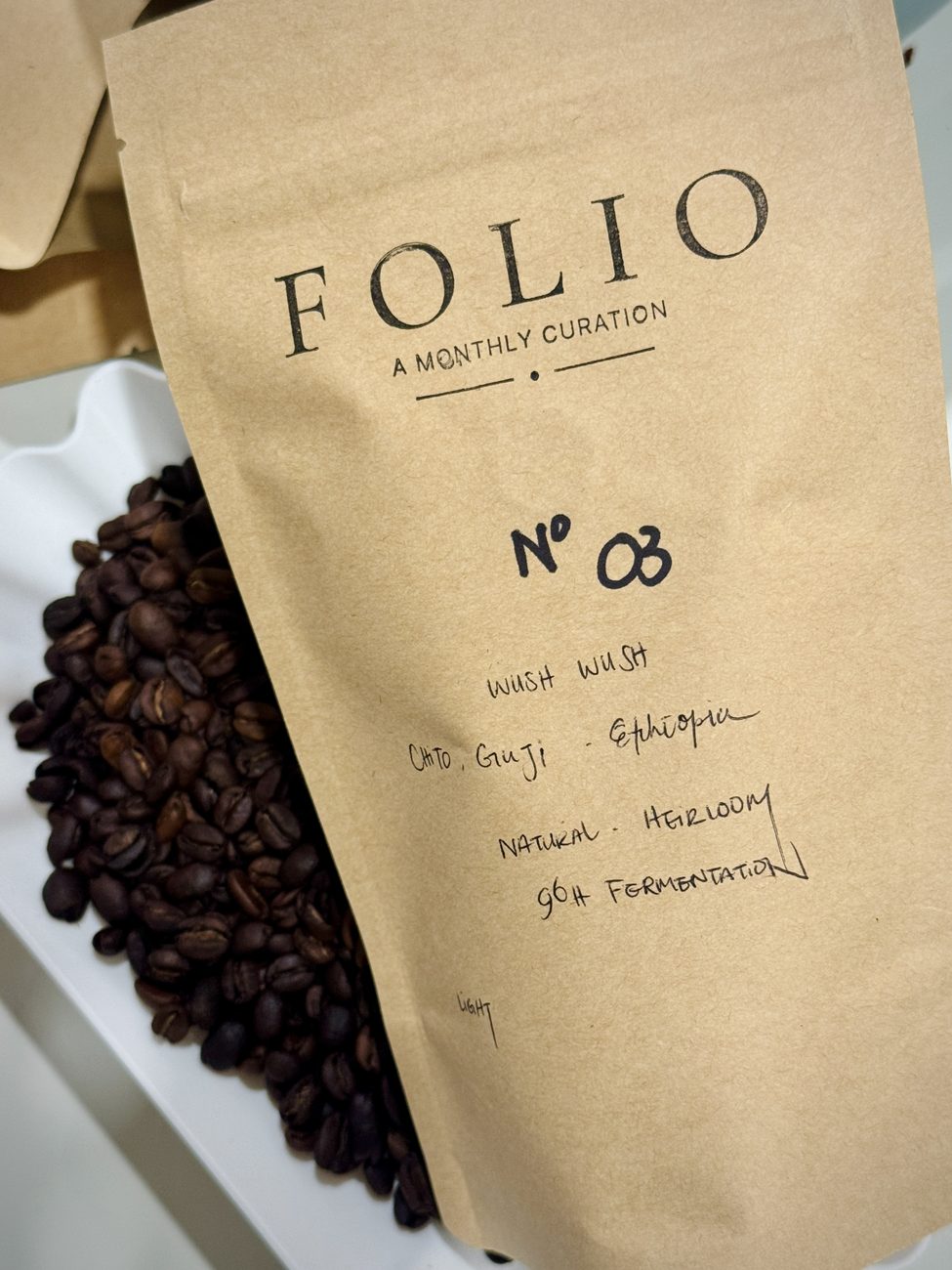
No03

Wush Wush

Nº 03

Wush Wush

A natural-process Ethiopian, named for the town it came from.
Origin
Chito, Guji, Oromia, Ethiopia
Producer
Area smallholders
Varietal
Wush Wush
Process
Natural (96h dry ferment)
Elevation
Up to 2,300 m+
Roast
Medium, on the lighter side

The seller's cup runs loud: melon, papaya, cherry cordial, tangerine, with a savory sun-dried-tomato edge. Ours to come once we've sat with it.

FOLIO · ETHIOPIA · 120G
July Selection · What's in a name

I bought this coffee because I liked the way it sounded.

Wush Wush. Say it out loud, that's half the fun. I saw it on the Roastmasters list, said it a few times, and ordered a pound before I'd read a single tasting note. Not my most disciplined sourcing decision. But names carry more than you'd expect, and this one turned out to have a whole argument folded inside it.

What "Ethiopian" actually means

Here's something I only half understood until this bean sent me reading. When you buy coffee from most of the world, the label tells you the variety. Bourbon, Caturra, Gesha, SL28. Growers track it, because the variety tells you a lot about what ends up in the cup. Ethiopia mostly doesn't bother. Look at an Ethiopian bag and the variety line usually says one word: heirloom.

That word does a lot of quiet work. Ethiopia is where coffee comes from. Arabica is native to those forests, and most of the coffee grown everywhere else on earth traces back to a small handful of trees that left Ethiopia centuries ago and got bred and re-bred into the varieties we name today. Which means the genetic diversity still sitting in Ethiopia is on another scale entirely. Not a few dozen named varieties, but so many distinct local ones that no one has finished counting them.

So "heirloom" isn't laziness. It's an admission. There are more kinds of coffee growing around one Ethiopian village than in some entire coffee-producing countries, and a lot of them don't have names because nobody ever needed to name them.

Coffee that grows in the backyard

The farming is part of it too. In much of Ethiopia, coffee isn't a plantation crop in tidy rows. It grows next to the house, along the path, in the shade behind the family plot, passed down through generations like a fruit tree you inherited rather than a business you started. Come harvest, a community picks and processes together and sells the lots pooled. That's not how it works in most places I buy from, where a single farm and a single producer is the whole selling point.

I think that's why an Ethiopian coffee can feel less like one farmer's work and more like a whole place's work. The place is the author.

The one that got a name

Which is what makes Wush Wush interesting, and rare. It's an heirloom that got a name. The variety is named for the town it came from in southwestern Ethiopia, and it got singled out, propagated, and eventually planted as far away as Colombia because the cup was distinct enough to be worth tracking. In a country where the default is "heirloom, unnamed," Wush Wush is the exception that earned its own line on the bag.

This particular lot isn't from that town, though. It's a natural, grown by a handful of smallholders around Chito in the Guji area, up above 2,000 meters, dry-fermented for 96 hours and dried slow on raised beds. The fermentation is the loud part. Roastmasters calls the style "wine processed," which is a polite way of saying the ferment runs long enough to push the fruit right to the edge. That tracks with the variety's reputation, and with why I couldn't stop saying the name.

The roast

I roasted the first batch this month, and it came out well. Not a small thing to say, after the sour first cup that opened the Pink Bourbon saga last month. I stopped this one about a minute past first crack, before second crack had a chance to start. On a fruit-forward natural, that's the window: far enough to be sweet and developed, not so far that you cook off the thing you paid for. You can still ask for light or dark at checkout, and I'll roast it the way you want.

As for what's actually in the cup, I'm going to do the honest thing and wait until we've properly sat with it before I put my own notes in writing. What I can pass along is what the seller found, and it's a lot: melon and papaya on the ripe side, then barley, pecan, cherry cordial, tobacco, tangerine, and a strange savory sun-dried-tomato note underneath. Intense, but it clears. If that list sounds a little chaotic, so does the name. That feels about right.

More once we've cupped it. For now, the bag is ready, and it's a good one.

— JM
San Jose, July 2026

Colophon

Folio Nº 03 is a single release: 120g of Ethiopia Wush Wush, a natural-process Grade 1, roasted on a Kaleido M1 Lite in our garage. Each bag is roasted to order, light, medium, or dark, with a lighter medium recommended. Sourced from Roastmasters. Grown by area smallholders around Chito, exported by Leli Trading, processed at Biru Bekele's washing station in Guji, Oromia, Ethiopia.

Seller's cup notes: melon, papaya, barley, pecan, cherry cordial, tobacco, tangerine, and sun-dried tomato. Our own notes will be added after we cup it.

The list

Hear about the next release.

Runs are small. The list is how you hear about future releases before they go up. If you'd rather get a text someday, add your number.

No texts yet. We're just noting who'd prefer one. Email is how releases go out for now.

One list, low volume, leave anytime. Run by Jean-Marc & Nancy in San Jose · hello@folio.coffee